Guides
Upwork Direct Contracts for agencies: what they cost and what they protect
A Direct Contract lets an agency bill an outside client through Upwork at a 5% fee. The client must be new to Upwork, and the client-sent kind is closed to agencies.
On a $10,000 project a Direct Contract costs the agency $500, against up to $1,500.
Freelancer service fee in dollars at three published rates, by contract size · fee the agency pays, USD
Hover or tab through the chart for exact values.
Source: Upwork help center, read 2026-11-15: Direct Contracts (bring a client to Upwork) for the 5% rate; Learn about the Freelancer Service Fee for the 0% to 15% range and the typical 10% Enterprise rate.Upwork does not publish which rate a standard contract carries; 10% and 15% are points on its published range, not a forecast for your contracts.
Show the data
| Direct Contract, 5% | Typical Enterprise, 10% | Top of the range, 15% | |
|---|---|---|---|
| $1,000 contract | $50 | $100 | $150 |
| $5,000 contract | $250 | $500 | $750 |
| $10,000 contract | $500 | $1,000 | $1,500 |
| $25,000 contract | $1,250 | $2,500 | $3,750 |
An Upwork Direct Contract lets an agency bring a client it met outside Upwork onto the platform at a 5% freelancer service fee, against up to 15% on standard contracts. The client must be new to Upwork, pays its own marketplace fee and a Contract Initiation Fee, and deposits funds before work starts. Fixed-price money auto-releases 14 days after a submission if the client stays silent. A second, client-sent kind costs $49 a month per contract, has no payment protection and is closed to agencies.
5%
freelancer fee on a Direct Contract
0% to 15% on other contracts
14 days
client review before fixed-price auto-release
agency-sent contracts
$49
a month per active client-sent contract
paid by the client
7 days
to file a fixed-price dispute
after the client cancels
Upwork now runs two kinds of Direct Contract
The name now covers two products, and most confusion about Direct Contracts comes from mixing them up. Upwork's own pages describe each one separately.
- Freelancer-sent: "bring a client to Upwork". An agency or freelancer creates the contract from Find work, then Direct Contracts, and emails it to a client who has no Upwork account. This is the one an agency uses. Upwork's Direct Contracts article sets the fee at 5%, and the client-side article says funds are deposited upfront and stay protected until the work is approved (what the client sees).
- Client-sent: "bring a freelancer to Upwork". A client invites someone it found elsewhere. The client pays $49 a month per active contract plus a 3% payment fee, and Upwork says Payment Protection and dispute mediation are not included (send a direct contract to a freelancer). The same article says plainly that agencies are not eligible, and the invitee must never have had an Upwork account.
So when a post or a forum thread says "Direct Contracts have no protection", it is describing the client-sent kind. When it says "funds are held until delivery", it is describing the kind an agency sends. Everything below is about the agency-sent kind unless it says otherwise. The Direct Contract glossary entry has the short definition.
| Agency or freelancer sends it | Client sends it | |
|---|---|---|
| Who it is for | A client new to Upwork | A freelancer who never had an Upwork account |
| Can an agency use it? | Yes | No, agencies are not eligible |
| Freelancer or agency fee | 5% (0% for active Freelancer Plus) | No platform fees |
| Client fee | Marketplace fee up to 7.99% (3% by U.S. bank) plus a $0.99 to $14.99 initiation fee | $49 a month per active contract plus 3% (0% if eligible for U.S. ACH) |
| Funds held before work | Yes, deposit upfront, one milestone at a time | No escrow |
| Disputes | As on other Marketplace contracts | Payment Protection and disputes do not apply |
| Counts toward Job Success Score | Yes | Yes |
Upwork help center, read 2026-11-15: Direct Contracts (bring a client to Upwork); the client-side article on receiving a direct contract; Send a direct contract to a freelancer; How to join Upwork with a direct contract; What is the Client Marketplace Fee?; What is the Contract Initiation Fee on Upwork?
The fee is 5%, and the savings scale with the contract
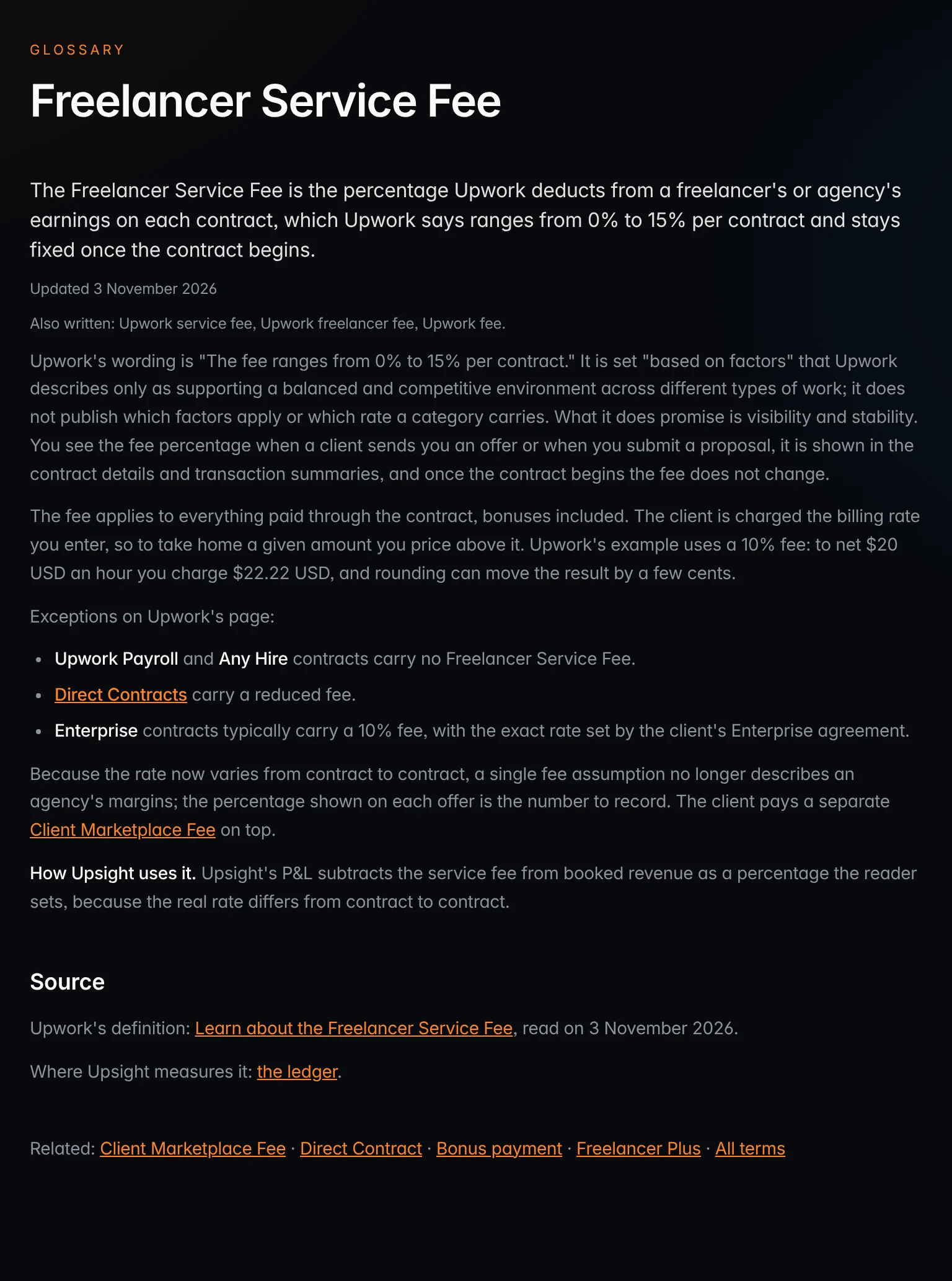
The agency pays a 5% freelancer service fee on a Direct Contract, calculated on the contract's total value: on $100 of earnings, $5. On other contracts Upwork says the fee ranges from 0% to 15% per contract and is fixed once the contract begins; it does not publish which factors set it, and Enterprise contracts typically carry 10%.
Because Upwork prints no standard rate, the chart compares the Direct Contract fee with two points on the published range. On a $10,000 project the agency keeps $9,500 on a Direct Contract, $9,000 at 10% and $8,500 at 15%. On a $25,000 retainer the gap to a 15% contract is $2,500.
The client side does not get cheaper. Upwork's Contract Initiation Fee article says Direct Contracts carry the same client fees as other Marketplace contracts: a Client Marketplace Fee of up to 7.99%, or 3% for qualifying U.S. clients paying by bank account (marketplace fee), plus a one-time initiation fee of $0.99 to $14.99 per contract. On a $10,000 project a client paying by card can pay up to $799 plus the initiation fee; by U.S. bank, $300 plus it. Tell the client this before you send, so the first invoice is not a surprise.
Only a client new to Upwork qualifies
The eligibility rule is short and strict. The client must not have an Upwork account: if it does, Upwork says the invitation fails with an error.
“Direct Contracts are only for clients who are new to Upwork.”
Four limits follow from that rule, all from the same article and the safety article:
- No conversions. An existing Upwork contract cannot be turned into a Direct Contract to cut the fee.
- No new accounts. Asking a client you met on Upwork to open a fresh account so you can send a Direct Contract breaks the Terms of Service. Upwork treats moving an Upwork client's work this way as circumvention.
- Supported work only. Off-the-shelf products such as pre-made software, and largely physical tasks, are outside the supported categories, which Upwork says change over time.
- One pending item at a time. If the client still has a pending proposal from you, it cannot accept a new Direct Contract until it answers the first.
Two rules matter for the long run. Every later contract with the same client must be started from the Direct Contracts page to keep the 5% (managing a direct contract); a plain offer sent from the workroom will not carry it. And the discount belongs to the person or agency that brought the client in: Upwork tells the client that working with anyone else means posting a job or sending a direct offer.
What protection a Direct Contract buys
For the agency-sent kind, Upwork says the contract works like other Marketplace contracts once the client accepts, with only the fee changed. That means escrow on fixed-price work. The client cannot activate a fixed-price contract without a deposit, and funds one milestone at a time: five $100 milestones make a $500 contract, and Milestone 1 is funded first (how the client accepts and pays). The client can pay by card or PayPal; Upwork says bank accounts may come later.
Fixed-price. After the agency submits work, the client has 14 days to approve or ask for changes. If it does nothing, Upwork releases the payment automatically. If the client cancels without paying, ends the contract short, or holds a milestone for delivered work, the agency can file a dispute within seven days of the cancellation (disputes on Direct Contracts). This is the same fixed-price protection a marketplace contract gets.
Hourly. The client is charged each Monday for last week's hours and has until Friday, four days, to dispute before the money is released. The agency cannot open an hourly dispute; it has three days to answer one, and a dispute pauses the contract with its weekly limit set to zero. Hours over the agreed weekly maximum can be refused and cannot be disputed. Upwork's Hourly Payment Protection article does not mention Direct Contracts. Log time as its rules require anyway: the Desktop App tracker, a described work diary, and staying inside the weekly limit. That is your best footing under Hourly Protection.
“Bonus payments can't be disputed.”
A client who stays silent for 14 days approves a fixed-price submission by default.
Published windows on a Direct Contract an agency sends, in days · days
Hover or tab through the chart for exact values.
Source: Upwork help center, read 2026-11-15: How to handle disputes on Direct Contracts; the client-side article on receiving a direct contract; How to accept and pay for a Direct Contract.
Show the data
| Days | |
|---|---|
| Client reviews a fixed-price submission before auto-release | 14 |
| Agency files a fixed-price dispute after cancellation | 7 |
| Client reviews last week's hours before Friday release | 4 |
| Agency answers a client's dispute of its hours | 3 |
The client-sent kind is not open to agencies
Agencies run into the client-sent kind in one way: a client found you elsewhere, opened an Upwork account, and asks why it cannot simply invite you. Upwork's answer, on send a direct contract to a freelancer, is that the invitee must never have had an Upwork account and that agencies are not eligible. An agency that is already on Upwork gets an ordinary offer or a job invitation from that client, at its standard fee.
This kind also differs in what it guarantees. On how to join Upwork with a direct contract, Upwork says payments are not held in escrow and Payment Protection and the dispute option do not apply; offers expire after seven days, and a fixed-price payment sits in a four-day security hold after the client approves it. Since July 2025, a client bringing its own freelancer gets this kind by default and cannot opt out. It is a payroll tool for people who already trust each other, not a protected contract. Upwork's separate Any Hire service is a third, different route with its own fees.
When an agency should move a client onto a Direct Contract
A Direct Contract is worth it when three things are true: the client is genuinely new to Upwork, the work is in a supported category, and you want a third party holding the money. The 5% buys escrow, a 14-day auto-release, a dispute path on fixed-price work and invoices the client can reconcile. It also builds the profile: Upwork counts Direct Contracts toward the Job Success Score, Rising Talent and Top Rated, and toward earnings totals.
It is a poor fit in three cases. A long-trusted client who pays on time by wire gains nothing from escrow, and its own fees rise by up to 7.99%. A client who already has an Upwork account cannot accept one. And any arrangement where the "outside" client was really met on Upwork is circumvention, whatever account it uses now. For the full picture of what an agency pays on and off Direct Contracts, read Upwork fees for agencies. Before you send any contract, vet the client the way you would on the marketplace.
Direct Contracts are for work an agency already won elsewhere; the marketplace is still where new clients come from. Upsight's campaigns sweep Upwork's job feed every 15 minutes, score each job against criteria the agency writes and what it has won, and draft from its knowledge profile. Its Connects and boost ledger is reconciled to Upwork's transactions, so the cost of winning marketplace work sits next to what it earns.
- 1
Confirm the client has no Upwork account
Ask before you send. If the client has one, the invitation fails, and you need a standard offer instead.
- 2
Agree the fees on both sides
You pay 5%. The client pays a marketplace fee of up to 7.99% (3% by qualifying U.S. bank) and a $0.99 to $14.99 initiation fee per contract. Say so in writing.
- 3
Create it from Find work, then Direct Contracts
Choose hourly with a weekly limit, or fixed-price split into milestones. Terms cannot be edited once sent; you withdraw and resend.
- 4
Wait for the deposit before starting fixed-price work
The contract is not active until the client funds the first milestone. Work done before that is outside escrow.
- 5
Start every later contract from the same page
A second project with the client keeps the 5% only if it starts from the Direct Contracts page, not as an ordinary offer.
- 6
Log hours to the protection standard
On hourly work, use the Desktop App tracker, describe the work in the diary and stay inside the weekly limit. Never bill hours over the maximum.
Questions
What is the Upwork Direct Contracts fee?
The freelancer or agency pays a 5% freelancer service fee, calculated on the contract's total value, so $500 on a $10,000 project. Active Freelancer Plus members pay 0%. The client pays its usual marketplace fee of up to 7.99% (3% by qualifying U.S. bank) plus a $0.99 to $14.99 Contract Initiation Fee.
Can an agency use Upwork Direct Contracts?
Yes, for the kind the agency sends: Upwork's client-facing article is addressed to clients whom a freelancer or agency invited. The agency pays 5%. Agencies are not eligible for the client-sent kind, which is only for freelancers who never had an Upwork account.
Do Upwork Direct Contracts have payment protection?
The agency-sent kind does: the client deposits funds upfront, fixed-price work auto-releases after 14 days of client silence, and the agency can file a fixed-price dispute within 7 days of a cancellation. The client-sent kind has no escrow, no Payment Protection and no dispute option.
Can I move an existing Upwork client to a Direct Contract?
No. Upwork says Direct Contracts are only for clients new to Upwork, existing contracts cannot be converted, and asking a client met on Upwork to open a new account for a Direct Contract violates the Terms of Service.
Do Direct Contracts count toward Job Success Score?
Yes. Upwork says feedback on Direct Contracts can affect the Job Success Score and Rising Talent or Top Rated status, and the contracts and earnings count toward the profile's totals, like any other contract.
Orhan G. Yalçın
Founder of Upsight and of Vizio AI, an Upwork agency that bids with Upsight every day. Every number on this blog comes with its sample, window and method. More about how we measure.
Terms in this post: Direct Contract · Freelancer Service Fee · Client Marketplace Fee · Freelancer Plus · Escrow · Fixed-Price Protection
Read next
Guides
Upwork fees in 2026 for agencies: every fee, with worked examples
The service fee now runs from 0% to 15% per contract, the client pays up to 7.99% on top, and Connects and withdrawals cost extra. Here is what an agency nets on $1,000 and $10,000.
Guides
Upwork Job Success Score: what moves it, what does not, and why it dropped
The JSS is the best of three rolling scores, recalculated daily. Most drops have a cause you can find in Upwork's own insights page, and some fix themselves on a date you can predict.
Data studies
How to vet an Upwork client before you bid: what 80,388 jobs show
Verified clients hire within 12 hours four times as often as unverified ones. They also draw a bigger crowd. Here is how to read the client panel, field by field, and weigh one against the other.