Guides
How Upwork fixed-price milestones and escrow work, from deposit to payout
A client funds a milestone, you submit, the client has 14 days, then a 5-day hold. Every published window on a fixed-price contract, and what happens when the client goes quiet.
A client gets 14 days to review your work; you get 7 to answer a refund request.
Published windows on an Upwork fixed-price Marketplace contract, in days · days
Hover or tab through the chart for exact values.
Source: Upwork help center, read 2026-11-18: How payments for milestones and fixed-price contracts work (211063718); How to file a dispute when your client doesn't pay a milestone (211068528); How to propose or respond to milestone changes (360023544173); What is arbitration on Upwork? (14044146250259).
Show the data
| Days | |
|---|---|
| Client reviews a submission before auto-release | 14 |
| You answer a refund request or file a dispute | 7 |
| Pending milestone change request expires | 7 |
| Either side agrees to arbitration and pays | 7 |
| Security hold before released money is available | 5 |
| Client answers your dispute | 5 |
| Both sides accept or reject the mediator's resolution | 2 |
On an Upwork fixed-price contract the client deposits each milestone into project funds (formerly escrow) before work starts, at $5 minimum. You deliver with Submit work, and the client has 14 days to approve, pay less, ask for changes or request a refund. Silence counts as approval and the money releases automatically. Released money then sits in a 5-day security hold. If the client asks for a refund, you have 7 days to accept or dispute, or the funds go back.
14 days
client review before auto-release
resets after each resubmission
5 days
security hold after release
shown as Pending
7 days
to dispute a refund request
calendar days
$5
minimum per milestone
and per fixed-price contract
Money moves through four states, and you are protected in two
Upwork's milestone payments article describes a fixed-price payment as a sequence of labels, and each one tells you who controls the money.
- Work in progress. The client has funded the milestone. The money sits in project funds, the deposit Upwork used to call escrow; the escrow company was renamed Payment Escrow Inc. in 2026 with no change to the rules. This is when you start work.
- In review. You pressed Submit work. The client now has 14 days to act.
- Pending. The client approved, or 14 days passed. The money is yours but held for five days against fraud and chargebacks.
- Available. You can withdraw it.
The client is charged when it funds, not when it approves: Upwork's deposit article says the card or bank is charged immediately, with the Client Marketplace Fee and a one-time Contract Initiation Fee taken at that moment. A funded milestone is money that has left the client's account; an unfunded one is a promise. Fixed-price payments do not qualify for faster payouts.
“Only milestone funds deposited in "project funds" are covered by Fixed-Price Protection.”
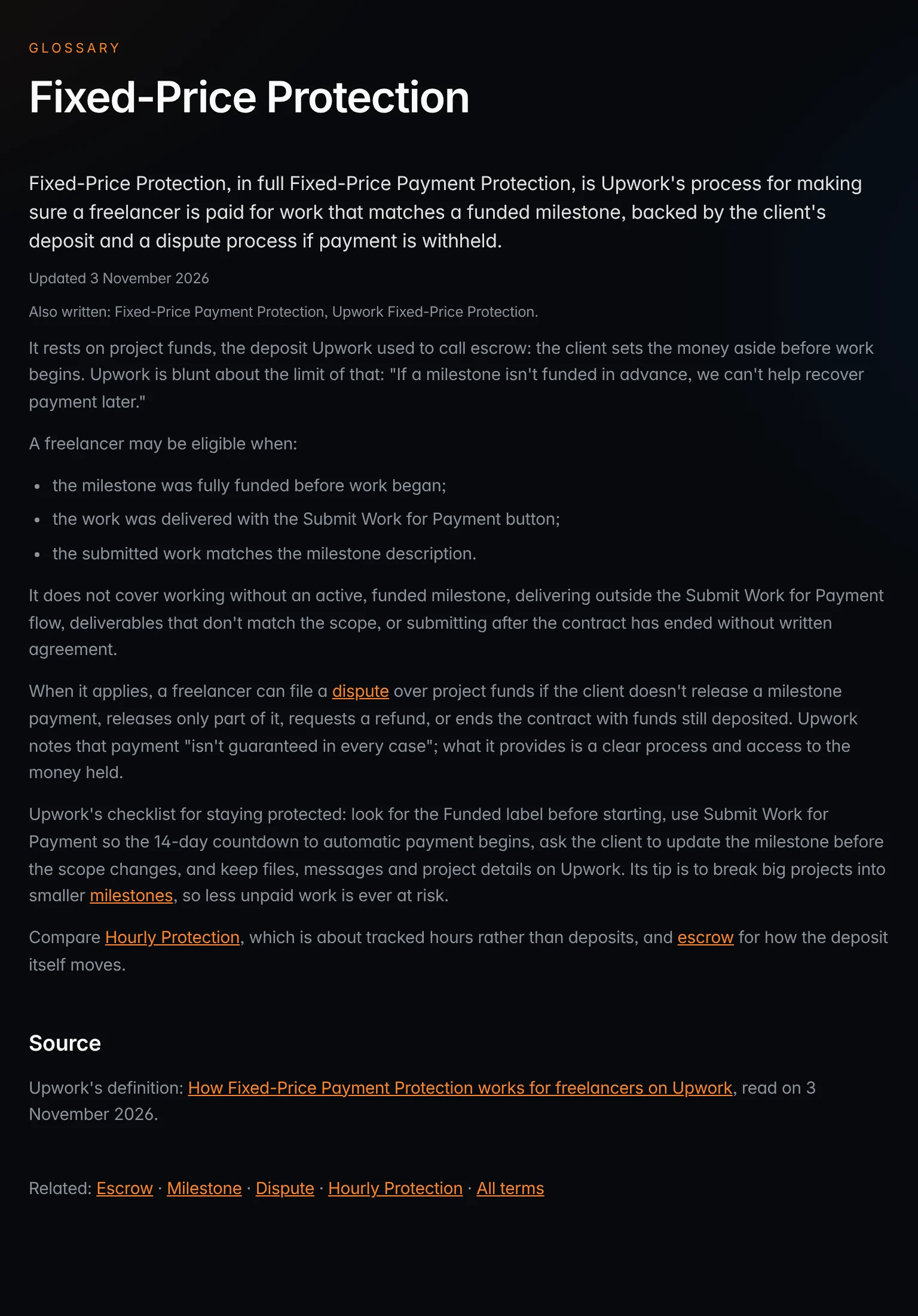
Fixed-Price Protection has three conditions, from Upwork's protection article: the milestone was fully funded before work began, the work was delivered through Submit Work for Payment, and it matches the milestone description. It does not cover work without an active funded milestone, files delivered outside that flow, scope that drifted from the description, or a submission after the contract ended without written agreement. Upwork says payment is not guaranteed in every case.
A milestone is funded one at a time, from $5
Every milestone has a $5 minimum, and so does a whole fixed-price contract (contract types). Upwork's milestones article says only one milestone is active at a time: the current one must be released before the next one activates. Its deposit article adds that a client can fund the full contract up front or only the first milestone. Read the two together: a client may deposit more, but you work and get paid one milestone at a time.
Changes have their own rules (milestone changes). You can propose changes only to future milestones. The client can change the active one only if nothing has been submitted against it. A pending change request is cancelled when you submit or the client releases, and it expires after seven days with no answer. Upwork's advice is plain: do not work on a milestone until the client has accepted and funded it.
For an agency this decides how you split a project. A $12,000 build in one milestone puts the whole fee behind one review. Six $2,000 milestones put at most $2,000 of unpaid work at risk at any moment ($12,000 / 6).
The 14-day clock starts at Submit work and nowhere else
The costliest fixed-price mistake is delivering the files and forgetting the button. Upwork's submit article says the 14-day window starts only when you use Submit work on the contract, even if the client already has the work.
Once you submit, the client has four choices (review and pay):
- Approve the full amount, optionally adding a bonus.
- Pay less, with an optional message. The remainder can move to the next milestone or be refunded, and you can agree or dispute (milestones).
- Request changes. Payment holds until you resubmit, and a fresh 14-day window starts.
- Do nothing. After 14 days Upwork releases the money to you automatically.
The chart puts the published waits side by side. A client who approves at once gets you paid in about five days, the hold. A client who stays silent gets you paid in 19, which is 14 days of review plus 5 of hold. One round of changes can stretch that to 33 days at most: 14, plus another 14 after you resubmit, plus 5. These are ceilings, not averages; Upwork publishes no approval-speed figures.
A silent client still pays in 19 days; one round of changes can stretch it to 33.
Longest wait from Submit work to available money under each path, in days · days
Hover or tab through the chart for exact values.
Source: Upwork help center, read 2026-11-18: How payments for milestones and fixed-price contracts work (211063718); Review and pay for fixed-price contracts and milestones (17974824831507).Maximums built from the published windows, assuming you resubmit the same day. Upwork does not say whether the 14 days are calendar days.
Show the data
| Client review | Security hold | |
|---|---|---|
| Client approves at once | 0 | 5 |
| Client stays silent | 14 | 5 |
| Client asks for changes once, then silent | 28 | 5 |
When a client asks for the deposit back, you have seven days
A client cannot pull a funded deposit on its own. Ending a contract with funds still held, or choosing "Pay nothing and request a refund", sends you a refund request (deposit refunds, ending a contract). From there the clock runs on your side.
You have seven calendar days to approve or dispute it. Upwork's dispute article is blunt: if you do not dispute within seven days, the remaining funds go back to the client. On an ended contract you must leave feedback for the client before you can file. On an active contract where you submitted work and the client will not release it, Upwork tells you to ask the client to release and end the contract, then contact Support.
After you file, the client has five calendar days to answer (client's side). If it accepts, you get the money. If it says nothing, the requested funds are released to you. If it declines, with a reason and documents it cannot edit later, a mediator issues a non-binding resolution, typically within two days. Both sides then have two calendar days to accept or reject it.
Money already released is a different case. A client can ask for a refund of released fixed-price money for up to 180 days (released payments), but you decide whether to give a full, partial or no refund (refund requests). Mediation applies only if the payment was released within the last 30 days. One help page mentions requests up to 365 days old through Support (request a refund); plan on 180. A refund that takes your earnings on a contract to $1 or less removes the contract and its feedback from both work histories, which matters for your Job Success Score.
Arbitration is the last step, and it costs both sides
If either side rejects the mediator's resolution, or one does not answer within two days, Upwork issues a Notice of Non-Resolution. Binding arbitration is then available on fixed-price contracts, run by an outside provider Upwork names as Brief (arbitration). Each side has seven days after the notice to agree and pay.
The fee rules shape the decision more than the merits do:
- In most cases the freelancer and client split the cost evenly. Upwork pays part of it only when the contract is over $20,000, and it does not print the fee.
- On funds still in project funds: if both sides decline arbitration, the money goes to the client. If only one side pays, the money goes to that side. If both pay, the arbitrator decides.
- On money that was never deposited, mediation comes first; if both decline, the case closes, and one side can pay the full fee to force a binding answer.
- Ignoring an arbitration outcome leads to an account suspension.
Read the second rule twice: whoever refuses to pay loses the deposit. On a small milestone the fee can outweigh the claim, so size milestones to be worth defending.
| Step | Window | If the other side is silent | Next |
|---|---|---|---|
| Client ends the contract and requests a refund | You: 7 calendar days | Funds refunded to the client | You dispute |
| You file a dispute | Client: 5 calendar days | Requested funds released to you | Client declines, mediation |
| Mediator's non-binding resolution | Both: 2 calendar days | Notice of Non-Resolution | Arbitration offer |
| Arbitration offer | Both: 7 days to agree and pay | Both decline: funds to the client | Binding decision |
Upwork help center, read 2026-11-18: articles 211068528, 211062068, 211062058 and 14044146250259. Applies to money in project funds on a Marketplace contract.
What to do when the client goes quiet
A silent client is the case protection handles best, unless you end the contract yourself. Upwork's stops-replying article warns that ending before you submit can cost you that milestone's funds: finish, submit and wait 14 days for the automatic release.
If the whole contract stalls, the dormant contract process eventually settles it. A fixed-price contract with money still deposited and no activity for 90 days after the last milestone's due date turns dormant. Upwork warns both sides on day 76 and again on day 83, but only if the "A contract ends" email notification is switched on. At day 90 the client has seven days to act. If it does not, you are notified and have seven days to request release; the client then has 14 days to approve or dispute, and silence sends the money to you. If both sides stay silent, the deposit goes back to the client. Adding a milestone, with any due date, extends the contract by 90 days, and editing one resets the clock.
Bonus payments sit outside all of this. A bonus goes through the same five-day hold but is not covered by payment protection and cannot be disputed (bonus payments). Never let a client move part of the agreed price into a "bonus at the end"; it belongs in a funded milestone.
- 1
Split the project before the offer goes out
Size milestones so no single one holds more unpaid work than you can afford to lose or arbitrate. Each needs at least $5.
- 2
Write each description as a test
Name the deliverable, where it lives and how the client will check it. Protection compares the work with this text.
- 3
Start only on the Funded label
Check the contract page, not the client's message. Work before funding is outside protection, with no grace period.
- 4
Deliver with Submit work, every time
Share files where you like, then press Submit work on the contract. That starts the 14-day clock and nothing else does.
- 5
Put the 7-day refund deadline on someone's calendar
In an agency, refund requests go to whoever holds the contract. Route them to one owner who answers within a day.
- 6
Never end a stalled contract yourself
Submit, wait 14 days, and keep the contract open. Turn on the contract-ends email so dormant warnings reach you.
Fixed price suits agencies that can define the work
Fixed price is a large share of the market. In Upsight's job panel of 80,388 Upwork jobs posted 4 October to 2 November 2026, 39.7% were fixed-price. Those jobs drew 16.4 proposals at twelve hours against 23.8 for hourly jobs, and 13.5% had a hire within twelve hours against 5.3%. That is a speed-of-decision signal, not a final hire rate, which the panel cannot measure. Fewer rivals and faster decisions make it attractive, if you can scope tightly enough to be protected. For competition by category, see proposals per job. Before you bid at all, vet the client: a payment-verified client with a real spend history is the best protection you get.
Hourly work runs on different rules under Hourly Protection, which does not apply to fixed-price projects (how Upwork protects payments). For the fees on both, read Upwork fees for agencies.
Winning the fixed-price jobs is the other half. Upsight's campaigns sweep Upwork's job feed every 15 minutes, score each job against criteria the agency writes and what it has won, and draft from its knowledge profile and best-matched case studies. Its Connects and boost ledger is reconciled to Upwork's transactions, so the cost of winning a contract sits next to what it pays out.
Questions
How long does an Upwork client have to approve a milestone?
14 days from the moment you press Submit work on the contract. If the client approves, pays less, requests changes or requests a refund, the outcome follows that choice. If it does nothing, Upwork releases the milestone automatically. A change request restarts a fresh 14-day window when you resubmit.
How long is the Upwork security hold on fixed-price payments?
Five days. After the client approves or the 14-day review passes, the money shows as Pending for a five-day security hold against fraud and chargebacks, then becomes Available to withdraw. Bonuses go through the same five-day hold. Fixed-price payments do not qualify for faster payouts.
Is Upwork escrow safe for freelancers and agencies?
It protects money that is already deposited. The client funds a milestone before work starts, and if you deliver matching work through Submit work, you can claim it through review, auto-release and disputes. Work done before funding, files delivered outside Submit work, and bonuses are not protected. Upwork says payment is not guaranteed in every case.
What happens if an Upwork client requests a refund on a milestone?
You get 7 calendar days to approve the refund or file a dispute. If you do nothing, the remaining funds go back to the client. If you dispute, the client has 5 calendar days to answer, silence releases the funds to you, and a decline goes to a mediator, then optional paid arbitration.
Can an Upwork client get money back after releasing a payment?
Only if you agree. A client can request a refund of released fixed-price money for up to 180 days, and the freelancer or agency decides on a full, partial or no refund. Mediation is available only if the payment was released in the last 30 days. Released work is generally treated as approved.
Orhan G. Yalçın
Founder of Upsight and of Vizio AI, an Upwork agency that bids with Upsight every day. Every number on this blog comes with its sample, window and method. More about how we measure.
Terms in this post: Escrow · Milestone · Fixed-Price Protection · Dispute · Mediation · Fixed-price contract · Bonus payment
Read next
Guides
Upwork Direct Contracts for agencies: what they cost and what they protect
A Direct Contract lets an agency bill an outside client through Upwork at a 5% fee. The client must be new to Upwork, and the client-sent kind is closed to agencies.
Guides
Upwork fees in 2026 for agencies: every fee, with worked examples
The service fee now runs from 0% to 15% per contract, the client pays up to 7.99% on top, and Connects and withdrawals cost extra. Here is what an agency nets on $1,000 and $10,000.
Data studies
How to vet an Upwork client before you bid: what 80,388 jobs show
Verified clients hire within 12 hours four times as often as unverified ones. They also draw a bigger crowd. Here is how to read the client panel, field by field, and weigh one against the other.