Guides
Upwork screening questions: how to answer them so the client keeps reading
A client can attach up to five screening questions to a job. Most ask for a fact about you, not an opinion. Answer the fact first, prove it once, and stop.
Founder, Upsight · Published · 10 min read
In software and data work, your answers compete with 36 to 42 other proposals by the twelfth hour.
Average proposals per job 12 hours after posting, by Upwork group · average proposals per job 12 hours after posting
Marketplace 20.8
Hover or tab through the chart for exact values.
Source: Upsight's job feed: 79,245 Upwork jobs posted 2026-10-04 to 2026-11-02 whose proposal count was read about 12 hours after posting; group averages weighted by measured jobs.A count of proposals, not of answers read. Jobs without screening questions are included.
Show the data
| Proposals at 12 hours | |
|---|---|
| Web, Mobile & Software Dev | 42.2 |
| Data Science & Analytics | 36.4 |
| IT & Networking | 24.0 |
| Admin Support | 20.6 |
| Customer Service | 19.2 |
| Accounting & Consulting | 17.7 |
| Sales & Marketing | 16.2 |
| Design & Creative | 15.5 |
| Engineering & Architecture | 14.5 |
| Writing | 14.2 |
| Translation | 11.2 |
| Legal | 6.8 |
Upwork lets a client add up to five screening questions to a job post, picked from suggestions or written from scratch, and the proposal form asks you to answer them after the cover letter. Answer each one with the fact it asks for in the first sentence, add one line of proof the client can check, and stop. You can edit the answers for six hours after sending or until the client views the proposal.
5
screening questions per job, at most
Upwork, Post a job
6 h
to edit after sending
or until the client views it
20.8
proposals per job at 12 hours
79,245 jobs, Oct 2026
5 to 10 min
for a recorded video interview
English only, no retakes
What screening questions are, in Upwork's own terms
Screening questions are questions the client attaches to a job post while writing it. Upwork's client guide sets the limit in one line, and adds that clients choose from a list of suggestions or write their own (Post a job):
“You can add up to five screening questions for freelancers.”
On the freelancer side they are a fixed step of the proposal form. Upwork's submission steps run in order: terms, timeline, cover letter, the client's screening questions, work samples, then the boost decision and Send. The same article sets the edit window: most parts of a proposal, answers included, can be edited for six hours after sending or until the client views it. After that only the terms can change.
Upwork publishes no length limit or length advice for answers. It also publishes no data on how answers affect who gets hired. What follows is practice, not policy, and we say which is which.
Where the client reads your answers, and what Upwork does not say
Upwork does not document where screening answers appear on the client's side. Its client article on reviewing proposals describes a proposal as the bid and a cover letter, with work samples and sometimes certifications or a portfolio, sorted into Shortlisted, Messaged and Archived tabs. It does not mention the answers at all.
What Upwork does say is how a client decides to open a proposal: from a preview of the opening lines of the cover letter with your name, photo, badges, rate and JSS (Upwork's guide to unviewed proposals). So the safe assumption is that answers are read after the letter has earned the open, by a client who is now checking whether you are what the letter said.
That gives answers a different job from the letter. The letter wins attention. The answers confirm or break it. A strong letter followed by a vague answer to "What similar project have you done?" reads as a claim without evidence.
One exception changes the format entirely. Some job posts require a recorded video interview instead of a cover letter. Upwork's video interview article says it usually takes 5 to 10 minutes, must be in English, cannot be retaken once the proposal is sent, and that clients see the full video, an AI-generated summary and the transcript. The same answer patterns apply, spoken.
Most questions ask for evidence, so answer with a fact
Clients pick from suggestions or write their own, but the questions fall into a few kinds, and each kind has an answer shape that works.
| The client asks | What they want to know | Lead with |
|---|---|---|
| Describe a similar project you have done | Have you solved this exact problem before? | The project in one line: what, for whom (by type, not name), the result |
| Which tools or stack do you use for this? | Will I have to teach you? | The tools, named, matching the client's words where true |
| How would you approach this? | Did you read the post? | Your first concrete step, then the second |
| What is your availability or time zone? | Can we work together on my hours? | Hours of overlap and start date |
| What is your rate or estimate? | Are you in my budget? | A number or a range, and what it covers |
| Do you hold certification X? | A yes or no | Yes or no, then the detail |
| Start your answer with a word I chose | Did you read to the end? | The word, exactly |
| Share your email, phone or Skype | How to reach you | A polite no: keep contact on Upwork until a contract starts |
Kinds of question from Upwork's proposal guidance and typical job posts; the answer shapes are this guide's recommendation, not Upwork policy.
Six patterns that keep the client reading
These are the habits that separate an answer a client trusts from one they skim past.
- Answer in the first sentence. If the question is "Have you worked with Stripe Connect?", the first word is "Yes" or "No". Context follows.
- One checkable fact per answer. A project type, a number, a tool version, a date. Facts a client could verify in an interview, never ones you would have to walk back.
- Use the client's nouns. If the post says "storefront" and "headless", answer with those words, not your own synonyms. It shows you read the post.
- Do not repeat the cover letter. The client just read it. An answer that pastes the letter's second paragraph wastes the space and looks automated.
- Short, then stop. Two to four sentences answers most questions. Upwork gives no length guidance, so this is judgement: long enough to prove, short enough to read in a pile of twenty other proposals.
- Admit the gap, then bridge it. "Not Shopify Plus, but three standard Shopify stores with custom checkouts" beats a vague yes the interview will expose.
Good and bad answers, side by side
The examples below are written for this guide. They are not from real proposals or clients.
Example question: "Describe a recent project similar to this one." (A job asking for a Shopify speed fix.)
- Weak example: "We have extensive experience in Shopify development and have completed many successful projects for clients worldwide. Our team is passionate about delivering quality."
- Strong example: "Last quarter we cut a fashion store's mobile load time from about 6 seconds to under 3 by removing two unused apps and lazy-loading the hero images. The same three checks are where I would start on your store."
The weak answer has no fact in it. The strong one has a result, a method and a link back to this job. (If you use a number like that, it must be yours and true.)
Example question: "What is your availability?"
- Weak example: "I am available and flexible to work according to your needs."
- Strong example: "I can start Monday. I am in UTC+3 and work until 8 p.m., so we overlap 9 a.m. to noon your time (EST) every weekday, and I answer messages within a few hours outside that."
Example question: "Which tools do you use for bookkeeping clean-up?"
- Weak example: "I use all the major accounting tools and can adapt to whatever you use."
- Strong example: "QuickBooks Online daily, and Xero for two current clients. Your post mentions QBO with Stripe payouts, so I would start by reconciling the Stripe clearing account."
Each strong answer would survive a follow-up question on a call. That is the test.
Your answers are read in a crowd
How hard each answer has to work depends on the room. Twelve hours after posting, the average Upwork job had 20.8 proposals in October 2026, and a software job had twice that. In a field of forty, a client comparing answers stops at the first vague one.
The same data cuts the other way. In Legal (6.8) or Translation (11.2), the client reads every proposal, so a precise answer is more likely to be the reason you are shortlisted. Check your own category on Upwork categories by competition, and see proposals at 12 hours for how the count is read.
How to answer at scale without generic text
An agency sending many proposals a day cannot write every answer from scratch, and should not paste the same one everywhere. The way through is to reuse facts, not sentences.
- 1
Build a fact bank, not an answer bank
For each service, list the real projects (by client type), results with numbers, tools, certifications, team time zones and start dates. Answers get written from these facts per job. Store it once, alongside your knowledge profile if you use one.
- 2
Tag facts by member
A screening answer is about the person bidding. If a business manager submits for a member, the tools, time zone and certifications must be that member's, not the agency's best person's.
- 3
Write rules for the question kinds you see most
Lead with yes or no on capability questions; give a number on rate questions; never share contact details. Rules keep answers consistent without making them identical.
- 4
Make the answer say I do not know
If a question needs a fact you have not stored, the right draft flags it for a person, rather than inventing one or telling the client the context is missing.
- 5
Read answers next to the letter before sending
Check that no answer repeats the letter and that every fact matches the member. Use the six-hour edit window if something slips, before the client opens it.
- 6
Track replies by whether questions were answered well
Compare reply rate on jobs with and without screening questions. Upwork reports no such figure, so only your own records can tell you.
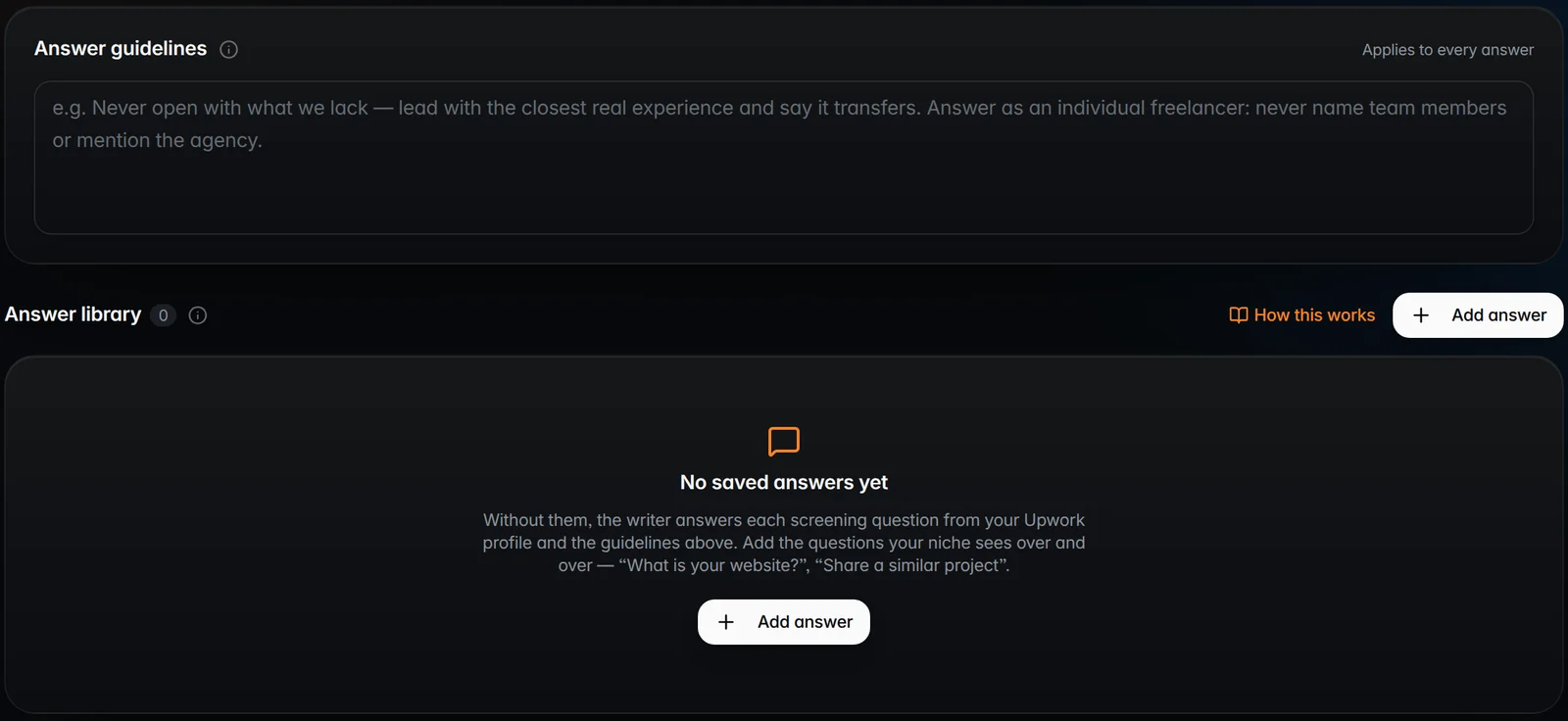
This is the shape Upsight's writer follows. A campaign can match only jobs that carry screening questions, and each answer is drafted from the bidding member's own Upwork profile and the agency's knowledge profile, with the agency's own answer guidelines taking precedence. Before the member's profile was added as evidence, about one answer in six in our own sends narrated missing context back to the client, which is exactly the failure step four guards against. Any campaign can require a person to approve every proposal, answers included, before it goes.
Questions
How many screening questions can an Upwork client add to a job?
Up to five. Upwork's job-posting guide says clients can add up to five screening questions for freelancers, chosen from a list of suggestions or written themselves. Freelancers and agencies answer them in the proposal form after the cover letter.
Can I edit my screening question answers after submitting an Upwork proposal?
Yes, for a short time. Upwork lets you edit most parts of a proposal, answers included, up to six hours after submitting it or until the client views it. After that, only the terms can change until the client accepts or rejects the proposal.
How long should Upwork screening answers be?
Upwork publishes no length limit or guidance. In practice two to four sentences answer most questions: the fact the question asks for first, one line of proof the client could check, and nothing repeated from the cover letter. With 20.8 proposals per job at twelve hours on average, shorter gets read.
Should I give my email or phone number in an Upwork screening answer?
No. Upwork does not allow contact information in proposals before a contract starts, apart from Enterprise clients and a few listed reasons. Offer to talk in Upwork Messages or on a call through Upwork instead; sharing details can lead to restrictions or losing the account.
Orhan G. Yalçın
Founder of Upsight and of Vizio AI, an Upwork agency that bids with Upsight every day. Every number on this blog comes with its sample, window and method. More about how we measure.
Terms in this post: Screening questions · Cover letter · Proposal · Communication outside Upwork · Knowledge profile
Read next
Agency playbooks
How to write an Upwork proposal that gets read: an agency playbook
A client decides whether to open your proposal from two lines and a profile card, often with 20 or 40 others waiting. Write those lines for the job, prove them once, and arrive early.
Data studies
How many proposals does an Upwork job get? We measured 79,245 jobs
Twelve hours after posting, the average Upwork job has 20.8 proposals. In AI integration work it has 61.6; in photography, 6.2. Where you bid decides how crowded the room is.
Data studies
What predicts a reply to an Upwork proposal? We measured 9,816 of ours
4.9% of our cold applications got a reply; 76% of our invitation responses did. Boosts, speed, weekends and client history moved the odds. Letter length, questions and an AI fit score did not.